
Guide · October 2026
A guide to traditional Rajasthani bridal jewellery
Borla, aad, timaniya, bajuband and hathphool explained — plus how kundan, meenakari and jadau differ, and how to plan a Shekhawati bridal set.
Borla, aad, timaniya, bajuband and hathphool explained — plus how kundan, meenakari and jadau differ, and how to plan a Shekhawati bridal set.
Rajputi and Rajasthani bridal jewellery has its own vocabulary, and families in Sikar and across Shekhawati often use the names interchangeably. Knowing what each ornament is — and what it is made with — makes it much easier to plan a set, compare designs, and decide which family heirlooms to bring into the wedding.
The core ornaments, head to hand
Borla (also called rakhdi) is the round, bell-like ornament worn at the centre of the forehead where the hair parts, held by a chain or thread; for many Rajasthani families it is the defining piece of a married woman's jewellery. A maang tikka with a flatter pendant is the more widely worn alternative.
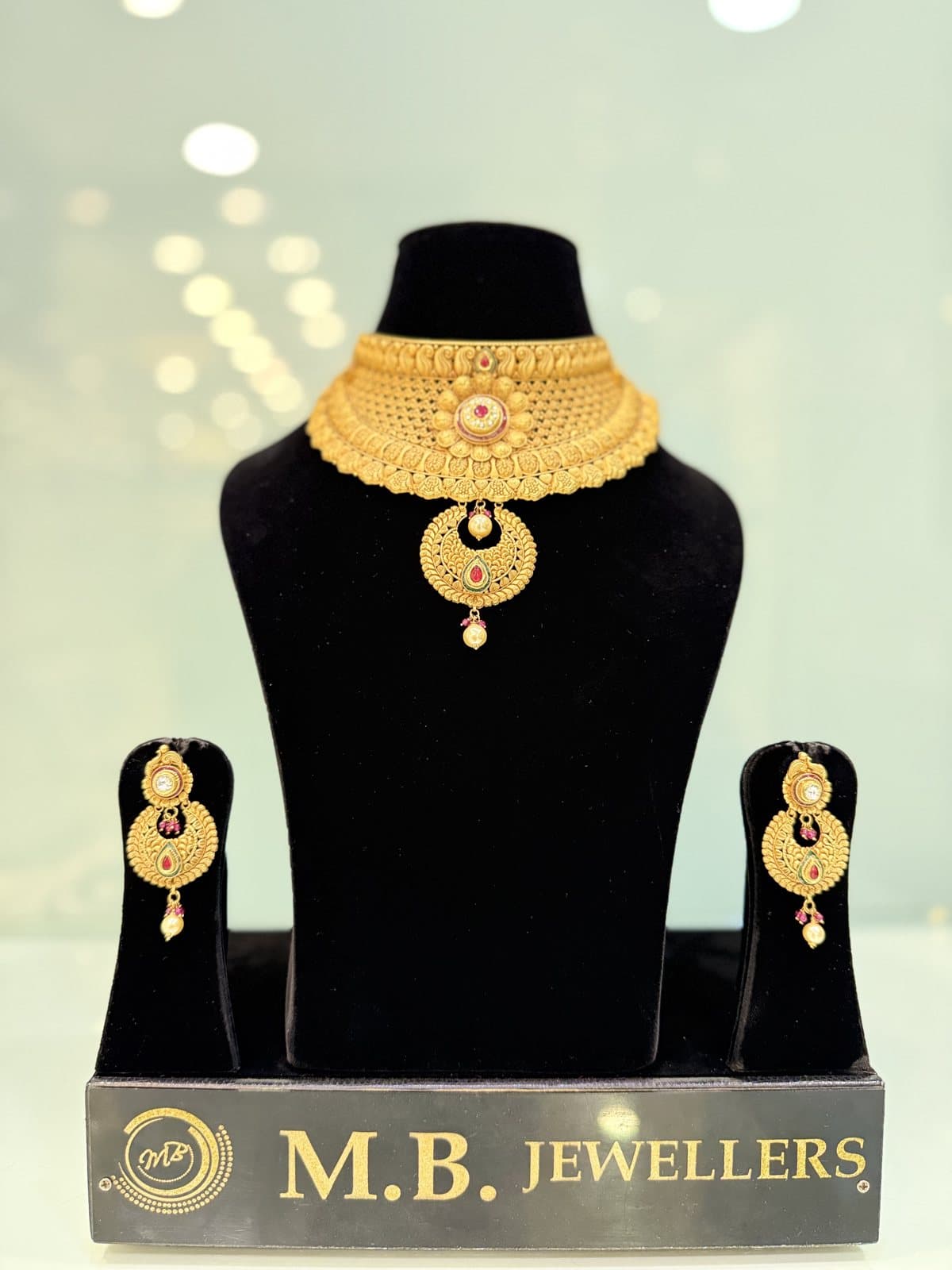
Aad is a broad, stiff choker that sits flat around the base of the neck, usually set with stones or kundan and finished with hanging drops. Timaniya is a related choker built from several panels joined together. Both are often paired with a longer necklace or a ranihaar so the neckline is layered rather than crowded.
Bajuband is an armlet worn on the upper arm, and hathphool (haathphool) is a hand ornament that links a ring to a bracelet across the back of the hand. Together with bangles, they balance the weight of a heavy necklace in photographs.
Kundan, meenakari and jadau — what the terms mean
Kundan refers to setting stones in highly refined gold foil rather than with prongs, giving the flat, mirror-like look associated with Rajasthani bridal sets. Jadau is the traditional craft of embedding stones into gold in this way, and the two terms are often used together.
Meenakari is enamel work — coloured enamel fused into engraved gold — and it is frequently found on the reverse of kundan pieces, so a necklace can be worn on either side. When you compare sets, ask which technique is used, what the stones are, and how the weight of gold is stated separately from stones and enamel.
Planning a Rajasthani bridal set
Start with the ceremony that matters most for photographs and choose its centrepiece first — usually the aad or a heavy necklace — then decide whether the borla, bajuband and hathphool should match it or contrast with it. Lighter functions can reuse the earrings and bangles.
Mixing new pieces with family jewellery is common. Bring heirlooms to the consultation so proportions, gold tone and stone colours can be checked side by side, and ask for the hallmark and HUID on any new gold piece.
You can browse Rajputi-style gold, ranihaar and bridal sets online, then book a private viewing at one of our two Sikar showrooms with your function dates and outfit colours ready.